What Every New Owner-Operator Needs to Do in Their First 90 Days of Authority
Share
Getting your operating authority is one of the best days in a trucker's career.
And then the paperwork starts.
In our combined 60+ years of compliance work — and managing compliance for over 120 active clients — the operators who stay out of trouble in year one aren't the ones who know the most. They're the ones who get the right things in place early and build good habits from the start.
This post is your 90-day roadmap. Bookmark it, work through it, and check things off as you go.
Before You Turn a Wheel
These items need to be in place before you operate. If you have your authority and haven't done these yet, stop and take care of them first.
✅ BOC-3 — Process Agent Designation
A BOC-3 filing designates a process agent in every state where you operate. It's a federal requirement and must be on file before you can legally operate. This is handled through a BOC-3 filing service — not the government directly. Cost should be $20–$30.
✅ Operating Authority (MC Number)
You should already have this if you're reading this post, but make sure your authority is active — not just granted. You can verify your status at safer.fmcsa.dot.gov.
✅ Cargo and Liability Insurance
Your insurance must be on file with the FMCSA and meet the minimum requirements for your operation type. General freight requires a minimum of $750,000 in liability coverage. Hazmat requirements are higher.
✅ UCR Registration — Unified Carrier Registration
UCR registration is required for any carrier operating in interstate commerce. It's an annual registration and the fee is based on your fleet size. Register at ucr.gov — not through any third-party mailer.
✅ Drug & Alcohol Testing Consortium
Owner-operators are required to be enrolled in a DOT-compliant drug and alcohol testing program. You need a pre-employment test on file before you operate and must be enrolled in a random testing pool.
Week 1–2: Get Your Registrations in Order
✅ IFTA License — International Fuel Tax Agreement
If you'll be operating across state lines (and you will be), you need an IFTA license from your base state. This allows you to file one quarterly fuel tax return instead of filing with every state individually. Contact your state's DMV or department of transportation to apply.
Once you have your license, start tracking mileage by state and fuel purchases by state from day one. Do not wait until filing time to reconstruct this information.
✅ IRP Apportioned Plates — International Registration Plan
IRP plates allow your vehicle to operate in multiple states under one registration. These are issued by your base state and renewed annually. If you don't have apportioned plates, you'll need to buy trip permits every time you cross a state line — which gets expensive fast.
✅ MCS-150 — Motor Carrier Identification Report
This is your carrier profile with the FMCSA. It needs to be accurate and updated every two years (or within 60 days of a change in your operation). Verify your information is correct at safer.fmcsa.dot.gov. This filing is free.
Week 2–4: ELD and Recordkeeping
✅ ELD — Electronic Logging Device
If you operate a commercial motor vehicle that requires a CDL and is used in interstate commerce, you are required to use an FMCSA-registered ELD to track your hours of service. Make sure your device is on the FMCSA's registered ELD list before you use it — not all devices qualify.
Your ELD provider should be able to help you set up state-by-state mileage tracking, which you'll need for IFTA.
✅ Driver Qualification File
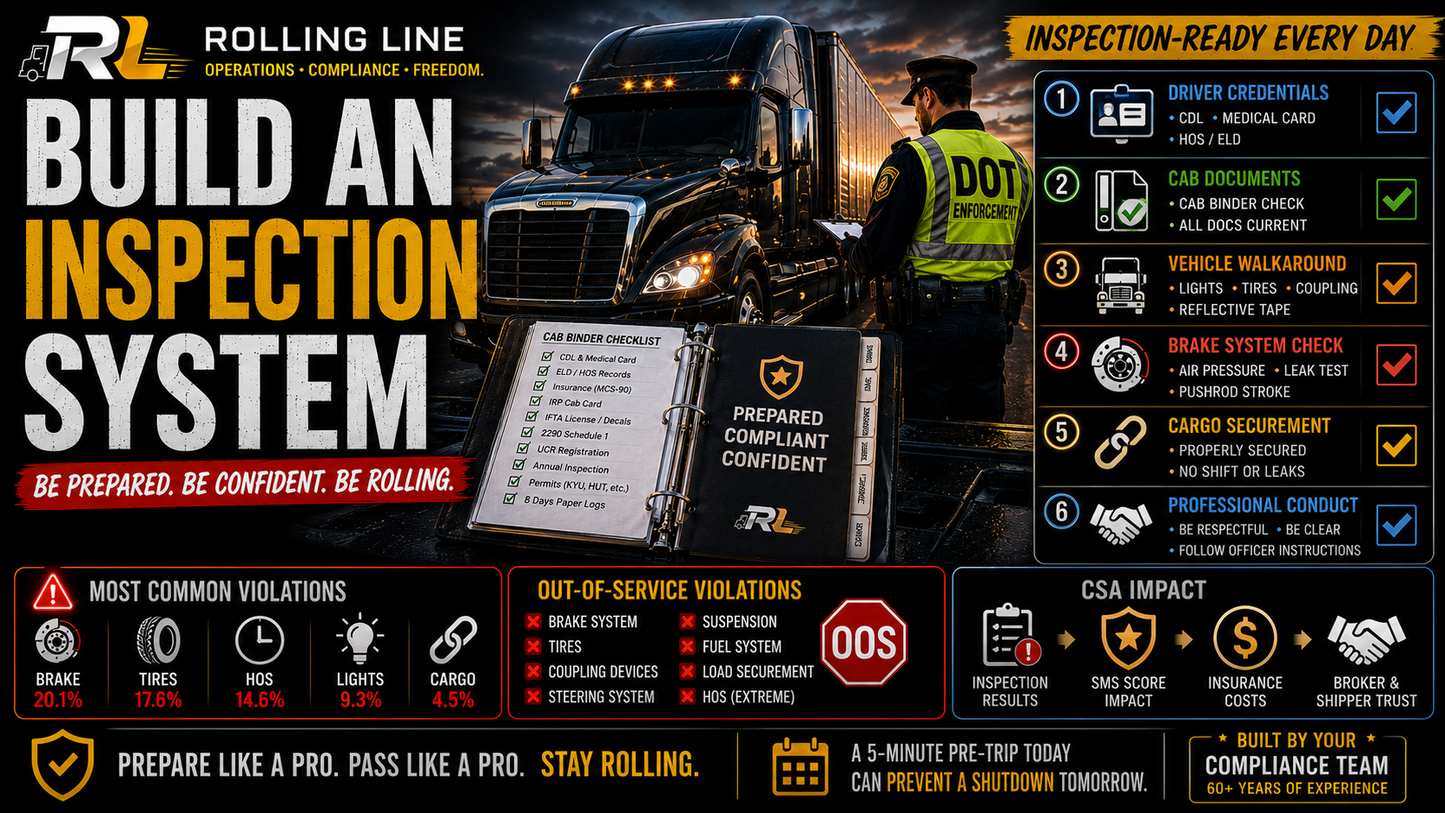
Even as a single owner-operator, you are required to maintain a driver qualification file on yourself. This includes your CDL, medical certificate, MVR (motor vehicle record), and other documentation. This is one of the most commonly overlooked requirements — and one of the first things an auditor will ask for.
✅ Vehicle Inspection and Maintenance Records
Start keeping records of every inspection, repair, and maintenance item from day one. FMCSA regulations require systematic inspection and maintenance of your vehicle, and you need documentation to prove it.
Days 30–60: Build Your Compliance Habits
✅ Set Your Quarterly IFTA Reminders
IFTA is due four times a year. Set calendar reminders now for April 30, July 31, October 31, and January 31. Missing a deadline is an easy penalty to avoid.
✅ Understand Your Hours of Service Rules
Hours of service violations are one of the top reasons carriers get flagged during roadside inspections. Make sure you understand the 11-hour driving limit, the 14-hour on-duty window, the 30-minute break requirement, and the 70-hour/8-day rule before a DOT officer explains it to you on the side of the road.
✅ Set Up Your Recordkeeping System
Whether it's a folder on your phone, a spreadsheet, or a compliance tool, you need a system for keeping your documents organized and accessible. The operators who struggle at audit time are the ones who never built a system — not the ones who built the wrong one.
Days 60–90: Review and Tighten Up
✅ Review Your Insurance Coverage
As your operation grows and you take on different loads, your insurance needs may change. Review your coverage at the 60-day mark and make sure it still matches what you're actually hauling.
✅ File Your First IFTA Return (if applicable)
Depending on when you started, your first quarterly filing may fall within your first 90 days. Don't miss it. Even if you drove zero miles in a quarter, you are still required to file a return.
✅ Update Your MCS-150 if Anything Has Changed
If your fleet size, operation type, or other information has changed since you filed, update your MCS-150 at safer.fmcsa.dot.gov. It's free and takes about five minutes.
✅ Review Your Safety Score
Check your SMS (Safety Measurement System) score at ai.fmcsa.dot.gov/SMS. Your score is based on roadside inspection results, crash data, and investigation history. Know where you stand before someone else tells you.
The Honest Truth About Year One
Most compliance problems don't come from operators who ignored the rules. They come from operators who didn't know the rules existed — or who knew they existed but didn't have a system for keeping up with them.
Year one is when the habits get set. The operators who build good habits early — tracking as they go, filing on time, keeping their documents organized — are the ones who run clean for years. The ones who don't tend to spend year two playing catch-up.
We break this down in our New Owner-Operator Compliance Guide — First 90 Days on the Road (Compliant & Confident) you can find that here.
https://shoprollingline.com/products/compliant-and-confident-your-first-90-days-on-the-road?utm_source=copyToPasteBoard&utm_medium=product-links&utm_content=web
If you want a complete year-one roadmap with every deadline, every filing, every requirement, and templates to track it all — that's exactly what we built our First Year Free and Clear Owner-Operator Compliance Guide for. It covers everything in this post and then some, with plain-English explanations and nine companion documents built for operators who are doing this for the first time.
[Learn more about First Year Free and Clear →]
https://shoprollingline.com/products/first-year-free-and-clear-the-complete-owner-operator-compliance-guide?utm_source=copyToPasteBoard&utm_medium=product-links&utm_content=web
And if you'd rather hand the compliance off entirely and focus on running your business, our team manages all of this for 120+ active clients every month. We've been doing it for 60+ years and we'd be glad to do it for you too.
[Learn about Hire Our Team →]
https://shoprollingline.com/pages/compliance-services
Not sure where you stand? Grab our free Scam Shield guide — use code CHECKLIST at checkout — and get started from there.
[Get Scam Shield Free →]
https://shoprollingline.com/products/scam-shield-reference-guide-for-new-carriers?utm_source=copyToPasteBoard&utm_medium=product-links&utm_content=web
Casey, Shane & The Rolling Line Team specialize in trucking compliance for owner-operators and small fleets. We manage compliance for 120+ active clients and have been doing this work for a combined 60+ years.