What DOT Officers Actually Check During a Roadside Inspection (And What Gets You Put Out of Service)
Share
Most owner-operators dread seeing those flashing lights in the mirror. But here is the thing, the operators who dread them the most are the ones who are never quite sure what the officer is going to find.
The operators who take inspections in stride already know what is coming because they checked everything themselves before they ever even decided to leave the yard.
After 60+ years of combined trucking compliance experience and working with over 120 active clients through roadside inspections, DOT audits, and safety reviews, we know exactly what officers look for and what separates a clean inspection from an expensive one. Here is the full picture.
What Is a Roadside Inspection and Why Does It Matter Beyond the Side of the Road?
A roadside inspection is not just an inconvenience. Every inspection result is recorded in the FMCSA's Motor Carrier Management Information System and tied to your USDOT number. Those results feed directly into your CSA score — the score that affects your insurance rates, your relationship with brokers and shippers, and your likelihood of being pulled in for a full DOT compliance audit.
A clean inspection helps your score. A violation hurts it. An out-of-service order hurts it significantly. And violations follow your operation for two years.
Understanding what gets checked is the first step to making sure every inspection works in your favor.
The Six Levels of Inspection
Not every inspection is the same. The North American Standard Inspection Program defines six levels of inspection with different scopes.
Level I is the full inspection: driver documents, a complete vehicle walk-around, and an under-vehicle check. This is the most common and the most comprehensive. Level II is a full walk-around without the under-vehicle inspection. Level III focuses on the driver only credentials, hours of service, and fitness. Levels IV through VI cover special studies, vehicle-only inspections, and radioactive shipment inspections.
If you can pass a Level I clean, every other level is a subset of what you are already prepared for. Level I is the one to be ready for every time you turn a wheel.
---
What Officers Check - The Driver Side
In a Level I or Level III inspection, officers typically start with you before moving to the vehicle.
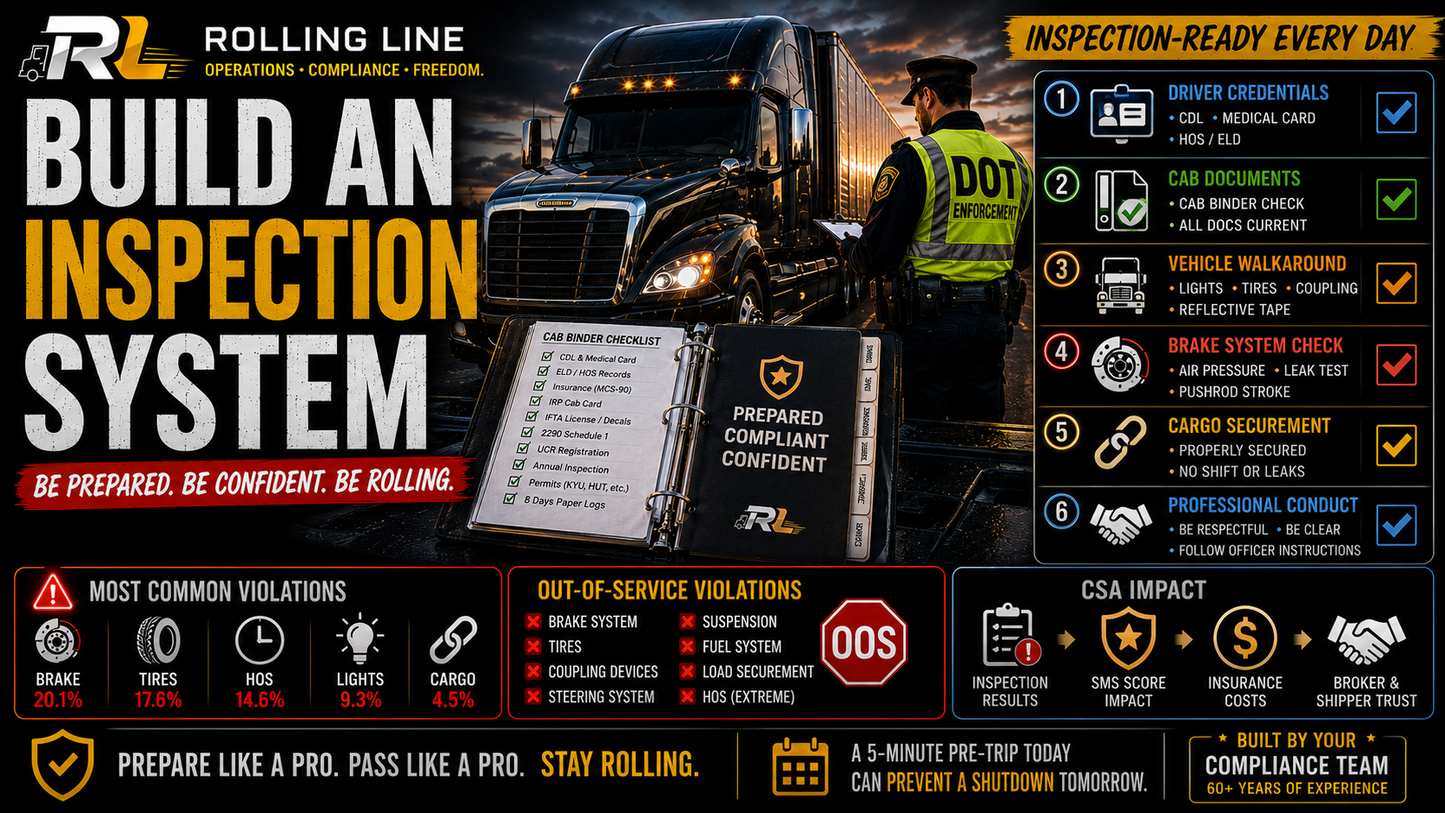
1. Your CDL must be valid, the right class for the vehicle you are operating, and carry the correct endorsements for your load. An expired CDL is an automatic out-of-service violation there is no grace period.
2.Your medical certificate must be current and issued by a certified medical examiner on the FMCSA National Registry. Know your expiration date. Set a calendar reminder 90 days out. Do not wait until the last month to schedule your renewal appointment.
3. Your hours of service records the officer will review your ELD or paper logs for the current day and the previous 7 days. They are looking for driving beyond your 11-hour or 14-hour limits, missing rest periods, and gaps or inconsistencies in your records. Know your numbers before you roll. An officer who asks how many hours you have left and gets a confident, accurate answer has less reason to dig deeper.
5.Your ELD must be on the FMCSA registered device list and you must be able to transfer your logs on request. Know how to do this with your specific device before an officer asks you on the side of the road.
---
What Officers Check -Your Cab Documents
Beyond your personal credentials, your cab must contain a specific set of documents. Physically present not on your phone, not at the office.
Your IRP cab card must be current and not expired. Your certificate of insurance including MCS-90 endorsement. Your annual DOT inspection report. Your current IFTA license and decals. Your 2290 Stamped Schedule 1. Your UCR registration receipt. State-specific permits if you operate in Kentucky, New York, New Mexico, or Oregon. Your ELD reference card. Your medical certificate. A CDL copy. Eight days of blank paper logs as ELD backup.
An expired document is the same as a missing document. Check your cab binder at the start of every month.
---
What Officers Check - The Vehicle
1. Lights are the most common category of violations found during inspections and the most preventable. Every headlight, taillight, brake light, turn signal, marker light, and clearance light must work. Every piece of reflective tape must be present and in good condition. All trailer lights must function and the pigtail must be properly seated. A five-minute light check before departure eliminates the most common violation category entirely.
2. Brakes are the highest-stakes inspection category. Officers measure brake pushrod travel, check lining thickness, inspect brake drums, and listen for air leaks. Brakes adjusted beyond allowable limits are the single most common out-of-service defect. Your pre-trip air brake check building pressure, timing the drop, verifying low air warning and spring brake activation should be non-negotiable before every departure.
3. Tires must meet minimum tread depth requirements: 4/32 inch on steer axles and 2/32 inch on drive and trailer axles. Sidewall damage with exposed cord is an out-of-service violation regardless of tread depth.
4. Coupling devices the fifth wheel must be lubricated, the locking jaw fully engaged, and the mounting secure. Perform the tug test after every hookup. Glad hands and air lines must be properly connected with no chafing or kinking.
5. Cargo securement cargo must be secured against movement in every direction with adequate tie-downs in good condition. Officers check working load limits and tie-down condition. Damaged straps are violations waiting to happen.
---
What Gets You Put Out of Service
An out-of-service order means you cannot move the vehicle until the defect is corrected. You call a mechanic you do not drive to a shop.
On the driver side: operating beyond your HOS limits, an expired or suspended CDL, no valid medical certificate, or any drug or alcohol violation will put you out of service immediately.
On the vehicle side: brake adjustment beyond limits, cracked brake drums, significant air pressure loss, tire tread below minimums, exposed cord on any tire, cracked frame rails, broken main leaf springs, steering defects, fuel leaks, and exhaust leaks into the cab are all out-of-service conditions.
The cost of an OOS order goes beyond the roadside inconvenience. Delayed loads, missed delivery appointments, broker notification, and a significant hit to your CSA score none of it is worth skipping a pre-trip inspection.
---
The One Thing That Prevents Most Violations
A thorough pre-trip inspection before every departure.
Not because it is required though it is but because an operator who inspects their vehicle properly before they leave simply does not have the violations that get other operators put out of service. The light that would have been caught in a five-minute walk-around is the light that triggers a Level I inspection three states away.
Build the habit. Every departure. Every time.
---
Want the Complete Guide?
Our Roadside Inspection Ready guide walks through every inspection category in detail including a full systematic pre-trip inspection routine you can work through from cab to rear of trailer. It also covers how to conduct yourself during an inspection, how to contest incorrect violations through DataQs, and how to track your CSA score.
Product is listed below!
And if you want our team monitoring your compliance and keeping your operation inspection-ready year-round, that is what our compliance services are for.
Learn about Hire Our Team
https://shoprollingline.com › pages › compliance-services
---
*Casey, Shane & The Rolling Line Team have been helping owner-operators navigate DOT compliance for a combined 60+ years. We manage compliance for 120+ active clients and we built Rolling Line so operators never have to figure this out alone.*